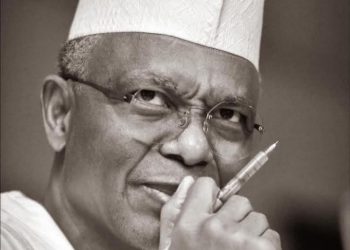
For more than two decades, I have followed Sheikh Dr. Ahmad Abubakar Mahmud Gumi – first as a young man in Kaduna seeking knowledge, and later as his Webmaster, archivist, and Head of Media and Publicity. In these years, I witnessed a scholar who combined intellect, courage, sincerity, and sacrifice in ways rare to find in modern Nigerian society. When people speak of him today, they often do so with fragments of quotes, edited clips, rumors, and propaganda. But those who know his real work – his writings, sermons, lectures, interventions, and warnings -understand that he stands among the few voices that attempted to stop the North from falling into the chaos that eventually consumed it.
Sheikh Dr. Ahmad Gumi is not a casual commentator. He holds an MBBS from Ahmadu Bello University, Zaria. He is a retired Nigerian Army officer, having served in the Infantry and attaining the rank of Captain. He is also an Islamic jurist with a PhD in Usul al-Fiqh from Umm al-Qura University in Makkah.
These three streams – science, military strategy, and Islamic scholarship – gave him a rare perspective on Nigeria’s crises. When he warned the nation, he spoke as someone who understood life, justice, governance, and conflict from inside and outside the system.
The earliest documented texts in our archive begin in 2012. Reading them today feels like revisiting a prophecy that Nigeria ignored until it was too late. In one of his earliest writings that year, he confronted the dangerous rise of mob killings disguised as religious defence.
He wrote, “Those who kill people because of alleged blasphemy without due process are committing murder, not defending the Prophet”. It was a courageous statement at a time when silence was safer, and when public fury often demanded blood rather than justice. Yet he insisted that Islam protects Christians, minorities, and even those who commit offences, until a defined legal process is fulfilled. This theme – protection of life, dignity, and coexistence – would reappear nearly every year of his writings.
In that same year, he warned that Nigeria’s moral decay, political manipulation, and religious ignorance were weaving a dangerous future. He wrote that “a society that abandons justice is already collapsing; it may not fall today, but the fall will come”. That collapse happened, exactly as he foresaw it.
While many were lost in sectarian politics, he tried to unite Muslims through NIMSA, a consultative assembly meant to bring together all Muslim groups – Sunnis, Izala, Tijjaniyya, Qadiriyya, Shia, and others. He wrote that “unity is not a luxury but survival,” and warned that politicians were exploiting Muslim disunity for their own gain. Today, the fragmentation of northern Muslim communities remains one of the core reasons insecurities could spread unchecked. Again, he saw it first.
His writings on Boko Haram that year were among the clearest and most balanced analyses Nigeria ever produced. He understood that Boko Haram was not a single entity. He described how some were misguided youths, others were criminals, and some were impostors sponsored by external forces or political actors.
He warned the government never to rely on mass arrests and extrajudicial killings, writing that “when innocent Muslims are arrested and killed without trial, it fuels hatred and rebellion”. This was exactly what happened. Government brutality became fertilizer for recruitment. Many later extremists were the younger brothers, cousins, and sons of innocent victims who were brutalized.
By 2013 and 2014, Gumi’s tone sharpened as corruption worsened. In a lecture delivered at ABU Zaria titled “Nigeria Is Infected with Leprosy,” he described the Nigerian state as a body whose nerves had died – unable to feel the pain of its citizens.
In his words, “corruption has killed our national conscience; a corrupt society does not feel shame, and a leadership built on corruption cannot lead anyone to safety.” He was among the first to link corruption directly with insecurity, long before international reports began saying the same.
When the Jonathan government mishandled the Boko Haram crisis, he criticized it. When the same mistakes – and worse – were repeated under President Muhammadu Buhari, he did not remain silent. He warned the North not to treat the 2015 election as messianic.
In one of his writings, he explained that “elections are not jihad; no political candidate represents Islam”. This warning was ignored, and the North placed exaggerated hope on a leadership that ultimately disappointed the region.
During Buhari’s presidency, when the killings in the North intensified, Gumi became one of the first scholars to publicly demand accountability. He asked hard questions: Why were people being massacred in Zamfara and Birnin Gwari? Why was intelligence failing? Why were security votes increasing but insecurity worsening? Why were military operations inconsistent and ill-planned? These were not attacks on Buhari; they were calls for leadership, for justice, for decisive action.
In 2016 and 2017, he wrote extensively about poverty and the collapse of rural livelihoods. He connected the dots between failing agriculture, cattle routes blocked by corruption, environmental neglect, and the growing frustration of rural youths. He warned that if the government did not address the grievances of pastoralists and rural communities, a full-scale rebellion would emerge. These were years before banditry became a national reality.
By 2018 – 2019, that rebellion had come to life. Banditry was no longer a fringe issue – it was a fire burning across Kaduna, Katsina, Zamfara, Niger, Sokoto, and Kebbi. Gumi described it as “an explosion-built overtime by government negligence, injustice, and economic decay.”
When he urged dialogue, he was not excusing crime; he recognized the failure of brute force in a situation where criminals were multiplying faster than the government could fight them.
His warnings against ethnic profiling were equally strong. When some began spreading narratives that all Fulani were bandits, Gumi warned that such narratives were dangerous and unjust. “Not all Fulani are criminals; criminals exist in every tribe,” he wrote in multiple articles. He rejected attempts to blame an entire ethnicity for the failures of governance. He insisted that injustice against any tribe would create more violence.
Between 2020 and 2023, when banditry became a national emergency, the government had exhausted military options and still failed. Communities begged for help. Victims’ families pleaded.
The forests were impenetrable. It was then that Gumi took the step that defined his public image for better or worse. He entered the forests. As someone who accompanied him into these missions, I saw firsthand that he went not with weapons or ransom, but with Qur’an, dialogue, and humanitarian concern.
Captives were released. Ceasefires were carried out in several localities. Hundreds of lives were saved. Yet the media, often misinformed or politically motivated, portrayed the mission as something else. Instead of asking why a private citizen had to do what the state failed to do, they attacked the man trying to help.
Through all this, he never changed his message. He continued to condemn killings, condemn kidnappings, condemn extremism, condemn corruption, and condemn injustice. He continued defending Christians and other minorities.
He continued insisting that Nigeria could not achieve peace without justice. And he continued warning that relying solely on force would fail because the state itself was corrupt, divided, and poorly coordinated.
His writings on elections, especially around 2023, remain some of the clearest analyses of Nigeria’s political decay. He wrote that “our problem is not who becomes president; our problem is the system itself.” He warned Nigerians not to idolize politicians, arguing that “politicians are not saviors; they represent themselves.” He reminded both Muslims and Christians that democracy is not holy war, and that no candidate is the representative of any religion.
By the time we reach his 2024 and 2025 writings, his reflections expand beyond the North. He discussed global hypocrisy, the crisis in Palestine, Islamophobia, moral decline in Western society, and the failures of Muslim leadership worldwide.
These writings show a scholar who had moved beyond the immediate Nigerian crises toward a global diagnosis of injustice and the erosion of conscience.
Yet, through all the years, one thing remained constant: he stood for justice, human dignity, and the sanctity of life. He wrote in 2012 that “Islam protects Christians living among us,” and he repeated the same in 2025.
He criticized Jonathan when necessary, criticized Buhari when necessary, criticized state governors when necessary, and criticized Muslims when necessary. His loyalty has always been to the truth, not to any tribe, party, or individual.
It is unfortunate that Nigeria listens to voices only after the damage is done. The writings of Sheikh Dr. Ahmad Gumi show that the North’s collapse into banditry, poverty, and bloodshed did not happen suddenly. It was a predictable outcome of corruption, injustice, failed governance, and moral decay. He warned us at every stage. We refused to listen at every stage.
Today, as communities struggle for survival, as insecurity spreads to every corner of the nation, as poverty deepens, as mistrust grows, as institutions weaken, and as leaders remain disconnected from the people they are meant to protect, we finally see what he saw more than a decade ago.
History will be kinder to him than his contemporaries were.
Sheikh Dr. Ahmad Abubakar Mahmud Gumi is not the man the propaganda machine portrayed. He is the man who tried to avert the storm. He is the man who understood the danger before the fire started. He is the man who stepped into the forest to save lives when the state had no strategy.
He is the man who defended Christians, protected Muslims, and confronted extremists. He is the man who told leaders the truth – even when they refused to hear it. He is the man who warned a nation addicted to denial.
And he is the man whose warnings, if taken seriously, could have saved thousands of lives.
* Malam Salisu Hassan is the webmaster & Head of Media and Publicity, Office of Sheikh Dr. Ahmad Abubakar Mahmud Gumi, Kaduna