
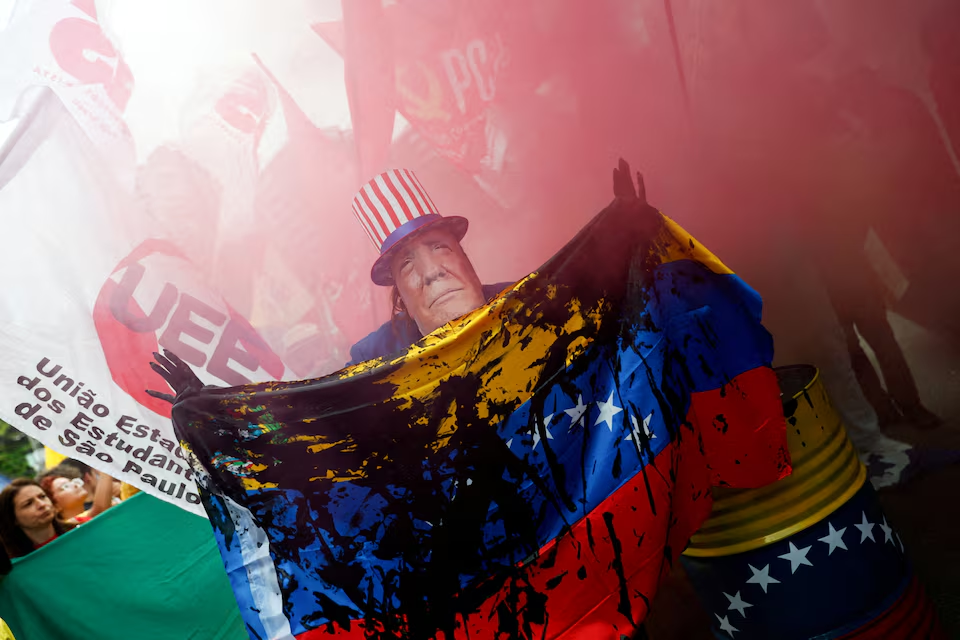
WASHINGTON/TOKYO/LONDON/BEIJING/MEXICO CITY, Jan 13 (Reuters) – He has toppled Venezuela’s leader, vowed to control its vast oil reserves and threatened other Latin American countries with similar military action. He has talked openly about annexing Greenland, even by force. And, beyond the Western Hemisphere, he has warned Iran that the U.S. could strike it again.
Ushering in the new year with a flurry of aggressive moves and fiery rhetoric just days before the first anniversary of his inauguration, President Donald Trump has taken a wrecking ball to the rules-based global order that the U.S. helped build from the ashes of World War Two.
That has left much of the world reeling, with friends and foes alike struggling to adjust to seemingly altered geopolitical realities. Many are uncertain of what Trump will do next and whether the latest changes will be long-lasting or can be undone by a more traditional future U.S. president.
“Everyone expected Trump to return to office with bluster,” said Brett Bruen, a former foreign policy adviser in the Obama administration and now head of the Global Situation Room consultancy. “But this bulldozing of the pillars that have long undergirded international stability and security is taking place at an alarming and disruptive pace.”
SPHERES OF INFLUENCE
While much is still unclear, Trump in a matter of months has demonstrated a taste for exercising raw American power, as he did with the bombing of Iran’s nuclear sites in June and the January 3 attack on Venezuela.
And he has signaled that he may intervene again, especially in the Western Hemisphere, where he has vowed to restore U.S. dominance, despite having campaigned on an “America First” agenda of avoiding new military entanglements.
This assessment of Trump’s shakeup of the global system draws on interviews with more than a dozen current and former government officials, foreign diplomats and independent analysts in Washington and capitals around the world.
On the global stage, Trump is resuscitating what much of the international community had long spurned as an outdated worldview – spheres of influence carved out by the big powers.
The inspiration is the 19th century Monroe Doctrine that prioritized U.S. supremacy in the Western Hemisphere and which Trump has embraced and reworked into the “Donroe Doctrine.”
Experts say that while the revival of this playbook may have unnerved some U.S. allies, it could also serve the interests of Russia, locked in a war in Ukraine, a former Soviet republic, and China, which has long had its sights set on Taiwan.
Following the U.S. attack on Venezuela – and Trump’s transparent play for the OPEC state’s vital resources – some of America’s staunchest allies have shown increasing concern about the undoing of the world order.
At stake is an international system that has taken shape over the past eight decades largely under U.S. primacy and though subject to occasional reversals had helped stave off worldwide conflict. It has come to be based on free trade, rule of law and respect for territorial integrity.
A White House official said the policies Trump is pursuing, including heavy focus on the Americas, the display of military might, a border crackdown and sweeping use of tariffs, were what he was elected to do and “we are seeing world leaders respond accordingly.”
Stephen Miller, an influential White House adviser, appeared to summarize the administration’s worldview when he told CNN on January 5: “We live in a world, in the real world … that is governed by strength, that is governed by force, that is governed by power.”
Europeans, already shaken by doubts about Trump’s willingness to defend Ukraine against Russia, have spoken out more openly in recent days, especially over his fixation with Greenland, an autonomous territory of Denmark, a fellow NATO member.
German President Frank-Walter Steinmeier last week accused the U.S. of a “breakdown of values” and urged the world not to let the international order disintegrate into a “den of robbers.”
Trump said on Friday that the U.S. needs to own the Arctic island to prevent Russia or China from occupying it, though Danish Prime Minister Mette Frederiksen has warned that a U.S. move to take Greenland would mean the end of the transatlantic alliance.
Amid the growing unease, some European leaders have suggested NATO should deploy forces in the Arctic to address U.S. security concerns.
SAFEGUARDING THEIR INTERESTS
Even before the latest developments, some U.S. allies had begun taking steps to safeguard against Trump’s sometimes erratic policies, including growing European efforts to boost its own defense industry.
Trump also has stirred anxiety among Washington’s Asian partners.
Itsunori Onodera, an influential Japanese ruling party lawmaker and former defense minister, wrote on X that the U.S. operation in Venezuela was a clear example of “changing the status quo by force.”
Trump’s berating of European allies and seeming tilt toward Russia last spring prompted a contingent of senior Japanese lawmakers to consider that the only nation to have been attacked with atomic bombs might have to develop one of its own.
In South Korea, Kim Joon-hyung, lawmaker of the progressive Rebuilding Korea Party, said Trump’s actions in Venezuela “opens a Pandora’s box where the strong can use force against the weak.”
In contrast, former Japanese Prime Minister Shigeru Ishiba told Reuters he did not see Trump’s Venezuela action as an “earth-shattering development” for the world order, though he questioned whether Trump’s increased focus on the Western Hemisphere was a message that “Europe, you’re on your own.”
Most friendly governments have had a largely muted response on Venezuela, reluctant to antagonize the U.S. president.
“Publicly scolding Trump is not going to help achieve our aims,” said one British official, speaking on condition of anonymity.
Leftist-governed Mexico was quick to criticize the U.S. ouster of Nicolas Maduro, Venezuela’s authoritarian socialist leader, but with so much at stake in relations with its northern neighbor, a senior Mexican official said it “will not go beyond publicly condemning the use of force.”
Trump, who has threatened unilateral military action targeting drug cartels inside Mexico and Colombia, told the New York Times in an interview last week that his authority as commander in chief is constrained only by his “own morality,” not by international law.
A NEW IMPERIALISM?
While critics accuse Trump of a new imperialism in Latin America, his defenders say it is long overdue, especially given China’s economic and diplomatic inroads in the region.
The White House official, speaking on condition of anonymity, said Trump was “rightfully restoring American influence,” especially by taking out Maduro, who he had accused of “poisoning” Americans with a flow of illegal drugs and sending Venezuelan migrants to the U.S.
“While the administration’s actions in Venezuela have shocked the world and sent a strong message to U.S. rivals in Beijing, Moscow, Havana, and Tehran, they are likely only the starting point for a longer-term and more comprehensive reappraisal of U.S. core interests in the hemisphere,” Alexander Gray, a senior fellow at the Atlantic Council and former foreign policy adviser in Trump’s first term, wrote on the think-tank’s website.
Trump’s approach carries risks for the U.S.
Key regional players such as Brazil could be pushed even closer to China as they hedge their bets against Trump’s pressure, some analysts say.
Most unsettling for U.S. allies has been Trump’s focus on Venezuela’s oil as a driving force behind the removal of Maduro. Washington has left the deposed president’s loyalists in power for now while strong-arming them to grant U.S. companies privileged access.
That use of U.S. power without any reference to international norms could, experts warn, embolden China and Russia to intensify coercive moves against their own neighbors. The White House official countered that U.S. adversaries had “undoubtedly taken note of the president’s strength.”
Zhao Minghao, an international affairs expert at Shanghai’s Fudan University, said the U.S. had “hyped up the notion of a ‘China threat’ in Latin America.” Soon after taking office, Trump spoke of taking back the Panama Canal and pressed the Panamanian government to reconsider Chinese-run facilities near the strategic waterway.
But Zhao also noted that Trump appeared supportive of major powers’ spheres of influence, an approach that many believe carries appeal for Beijing.
The prevailing view in Russia is that the U.S. attack on Venezuela, including taking Maduro to New York to face “narco-trafficking” charges, was a pure power play.
“That Trump just ‘stole’ the president of another country shows that there is basically no international law – there is only the law of force,” Sergei Markov, a former Kremlin adviser, told Reuters. “But Russia has known that for a long time.”
Trump’s appetite for further foreign military action may continue for targets well beyond the Western Hemisphere.
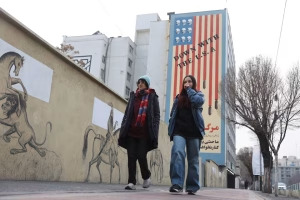
Even amid the fallout over Venezuela, he has threatened to intervene on behalf of protesters in Iran where Muslim clerical rulers are facing one of the stiffest challenges to their control since the 1979 Islamic Revolution.
On Sunday, Trump told reporters on Air Force One he was weighing possible responses, including military options.
“We may have to act because of what is happening,” he said.


