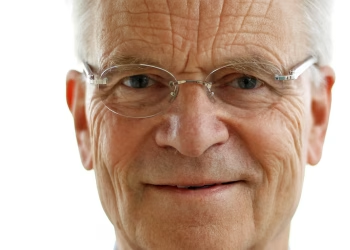
Winner of the 2026 edition of The Nigeria Prize for Literature, Ogaga Ifowodo (r), receives his prize from the Managing Director and Chief Executive Officer of LNG, Mr Adeleye Falade, as Professor Akachi Adimora-Ezeigbo, Chairman of the Advisory Board for The Nigeria Prize for Literature, watches with interest in Lagos on Friday
Nigerian poet, lawyer and pro-democracy activist Ogaga Ifowodo has won the 2026 edition of The Nigeria Prize for Literature with his poetry collection, Why Does God Need a Gun?, earning the $100,000 cash award.
Ifowodo, who hails from Delta State, emerged winner of one of Africa’s most prestigious literary awards with a collection that explores religious and political violence in Nigeria through the voice of an imagined victim.
Published by Masobe Books, the collection was selected from 223 entries for this year’s prize, sponsored by Nigeria LNG Limited (NLNG).
The winners were announced at the Grand Award Night in Lagos on Friday, October 9, 2026.
Ifowodo’s victory adds to a literary career spanning more than three decades. He won the Association of Nigerian Authors’ poetry prize in 1993 and was detained in 1997 for his pro-democracy activities during the military regime of the late General Sani Abacha.
He subsequently earned a PhD from Cornell University in the United States and has combined his work as a poet with careers in law, academia and human rights activism.
Announcing the winner, Professor Akachi Adimora-Ezeigbo, Chairman of the Advisory Board for The Nigeria Prize for Literature, described Why Does God Need a Gun? as a sensitive portrayal of religious and political violence in Nigeria, narrated through the voice of an imagined victim.
She also commended the three shortlisted poetry collections for their technical skill, confidence and mature use of language, noting that they engaged with issues extending beyond Nigeria.
“Equally compelling is the conversation that unfolds across the three books. Though distinct in voice and style, they engage with related concerns: questions of identity and belonging; the promises and disappointments of nationhood; the consequences of extremism and displacement; and the enduring impact of conflict on individuals and communities. These are works deeply rooted in the Nigerian experience, yet they reach far beyond our borders,” she said.
Ifowodo emerged from a longlist of 11 poets announced in July before making the final shortlist in August alongside James Ngwu Eze, whose collection is Unbind Me Now, and Tares Oburumu, author of Floral’s Love Colony.
The literature prize, established by NLNG in 2004, rotates among fiction, poetry, drama and children’s literature on a four-year cycle.
At the same ceremony, Peter Oghenetega Oke’s Beyond Tarkwa Bay and Feranmi Abiola’s Mara Mania were named joint winners of the inaugural Nigeria Prize for Creative Arts, which carries a $20,000 cash award.
The two documentaries emerged from 98 submissions, with the prize introducing a new category to recognise originality, authenticity and creative excellence.
Speaking on the five shortlisted documentaries, Joel Kachi Benson, Technical Adviser to the Advisory Board for The Nigeria Prize for Creative Arts, praised the filmmakers for bringing overlooked communities and experiences into public view.
“These documentaries transported us into communities often unseen. They amplified voices too often unheard. They celebrate resilience, document culture, preserve memory, and reveal perspectives that enrich our understanding of who we are,” he said.
The announcements followed the September 2026 declaration of Mary-Brenda Akoda as winner of The Nigeria Prize for Science and Innovation for her artificial intelligence-powered innovation, GenScan AI (GenMRI/C-MORE), which accelerates magnetic resonance imaging (MRI).
Akoda became the prize’s first Generation Z recipient and the first woman to win as an individual awardee.

In his opening remarks, NLNG Managing Director and Chief Executive Officer, Adeleye Falade, said the Nigeria Prizes were established to recognise outstanding achievements and encourage scientific innovation and literary excellence that enrich society and improve lives.
He noted that the Science and Innovation Prize had recognised groundbreaking contributions in health, agriculture, engineering, energy, technology, climate resilience and sustainable development.
“It has celebrated the ingenuity, dedication and brilliance of scientists whose work extends far beyond laboratories and research papers to deliver practical solutions that improve lives,” Falade said.
On the literature prize, he said it had become one of Africa’s most prestigious literary honours, providing a platform for Nigerian writers to contribute to global conversations.
“Through this prize, Nigerian writers have demonstrated that our stories are far more than accounts of where we come from. They contribute meaningfully to global conversations about identity, resilience and our shared humanity,” he stated.
He described the Creative Arts Prize as another platform for celebrating artists who preserve Nigeria’s cultural heritage while reimagining it for new generations.
“Together, the Nigeria Prizes have become enduring national institutions and powerful reminders of what is possible when excellence is recognised, rewarded and encouraged,” he said.
“Together, the Nigeria Prizes have become enduring national institutions and powerful reminders of what is possible when excellence is recognised, rewarded and encouraged” – Adeleye Falade, MD/CEO of NLNG
Falade congratulated the finalists and winners, saying their achievements demonstrated the importance of discipline, dedication and perseverance.
“As we honour this year’s laureates, we also hope to inspire the next generation of scientists, writers and creatives whose ideas will solve tomorrow’s challenges, tell tomorrow’s stories and shape tomorrow’s future,” he added.
Also speaking at the event, Nobel laureate Professor Wole Soyinka highlighted imagination as a common thread connecting literature, the creative arts and science.
He noted that imagination was not confined to the humanities, as disciplines such as mathematics and physics also depended on vision and the ability to conceive new possibilities.
Soyinka called for stronger collaboration between the humanities and the sciences to advance human welfare, urging practitioners in both fields to expand the boundaries of imagination and combine their strengths to build a better world.
Through the Nigeria Prizes, NLNG said it remained committed to recognising excellence, inspiring innovation and promoting a sustainable future.