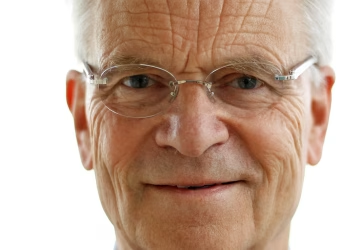
When I first retired, I thought happiness would come automatically. I had the dream setup: financial stability, freedom to do whatever I wanted, and no more deadlines or endless meetings.
I imagined waking up every morning with a sense of calm — sipping coffee while the world rushed around me.
But the truth? The first six months were strange. I felt directionless. I didn’t realize how much of my identity was wrapped up in working.
The quiet mornings I’d dreamed of felt a little too quiet. The open calendar felt like an empty page I didn’t know how to fill.
It wasn’t until I started making a few key changes — mentally, emotionally, and even spiritually — that everything clicked.
Now, five years later, I can honestly say I’m happier than I’ve ever been. Not because I stopped working, but because I learned how to live again.
Here’s what made all the difference:
1. I stopped chasing productivity and started embracing presence
For most of my adult life, my worth was measured by what I produced — income, goals, output, results.
When I retired, that instinct didn’t go away overnight. I felt guilty for relaxing. If I wasn’t “accomplishing” something, I felt useless.
But one day, while sitting in a park in Saigon, I noticed something simple: an old man feeding pigeons, completely content. He wasn’t rushing anywhere. He wasn’t on his phone. He was just there.
That moment shifted something in me. I realized happiness in retirement isn’t about staying productive — it’s about being present.
Now, my mornings aren’t about checking off tasks. I sit with my coffee, listen to the sounds outside, and actually taste the moment I’m in.
It’s not laziness. It’s freedom — the kind I never knew how to appreciate while working.
2. I built small rituals that give my days shape
When you stop working, you lose the natural rhythm of your days.
No commute. No lunch hour. No deadlines.
At first, that feels liberating. Then it starts to feel like chaos.
So I built gentle structure into my days — not rigid schedules, but small rituals that give me grounding. Every morning, I go for a run or a long walk. I cook lunch slowly, with music playing. I read for an hour in the afternoon. In the evenings, I take a moment to reflect — just a quiet check-in with myself and my wife.
These aren’t grand routines. But they remind me that the beauty of retirement isn’t in filling every minute — it’s in noticing the rhythm of your own life again.
3. I learned to separate purpose from work
For decades, I believed my purpose was my career. I think many people fall into that trap. When you retire, that illusion cracks. Suddenly, you’re forced to ask: Who am I without my job? At first, it’s unsettling. But eventually, you realize that purpose isn’t something your boss gives you — it’s something you create.
For me, it became writing. Sharing insights about mindfulness and psychology. Helping others live with a little more awareness.
For someone else, it might be gardening, volunteering, mentoring, or simply being a present grandparent. That’s exactly what Jeanette Brown explores in her brilliant course, “Your Retirement, Your Way.” It’s a warm, practical guide that helps you redefine purpose on your own terms, showing that retirement isn’t the end — it’s the beginning of a more meaningful chapter.
Purpose in retirement isn’t about achievement — it’s about alignment. Doing things that connect you to life, even if no one claps for them.
4. I started taking my health seriously — for the joy of it, not the fear
When I first retired, I had this vague goal of “staying healthy.” But it was rooted in fear — fear of aging, fear of losing independence. That mindset never inspired me. It just made exercise feel like a chore.
But one day, I reframed it completely. I stopped thinking of health as a duty and started treating it as a way to celebrate life. Now, I run because it makes me feel alive. I lift light weights because I love the feeling of strength. I stretch because it makes my mornings feel spacious. It’s no longer about avoiding decline — it’s about embracing vitality.
I’m 5 years into retirement, and I feel younger now than I did during my last few years of work. Not because I reversed aging, but because I stopped letting fear run my body.

5. I redefined what success means
When I was working, success was external — money, status, growth.
But retirement forced me to ask: what does success look like now?
It took me a while, but here’s what I’ve settled on: Success is waking up without dread. It’s being healthy enough to walk wherever you want. It’s having meaningful conversations with people you love. It’s looking at the sky and realizing — you’re not in a rush anymore.
Once I started measuring success in moments instead of milestones, life became richer. You stop comparing yourself to others. You start noticing how good it feels to simply exist well.
6. I let go of the need to be “useful” all the time
If you’ve worked your whole life, you probably understand this — that deep conditioning that your value comes from what you do. I had a hard time letting go of that.
Even after retiring, I kept finding projects to justify my time — consulting gigs, side ventures, endless plans.
Then one morning, my wife said something that changed me: “You don’t need to earn your right to relax.”
It hit me like a wave. I’d carried that invisible pressure my whole life — to always be useful, to always contribute.
But now, I understand: I don’t need to justify my existence. Rest is not waste. Stillness is not failure.
That’s been one of the greatest freedoms of retirement — the ability to simply be without apology.
7. I made peace with aging
In my first year of retirement, I avoided mirrors. I hated seeing the lines around my eyes deepen, or noticing how my stamina wasn’t what it used to be.
But over time, I realized something: resisting aging doesn’t stop it — it only makes you suffer more. Now, when I see those lines, I see evidence of a life lived — laughter, stress, growth, love.
In Buddhism, there’s a saying: “Impermanence is not something to fear — it’s the condition that makes everything beautiful.”
That truth landed deeply for me in retirement. I no longer chase youth. I cultivate vitality — of mind, spirit, and presence. And that feels far more lasting than any anti-aging cream or supplement.
8. I learned to value relationships over routine
During my career, I was constantly busy. My calendar was packed, my phone buzzing. “I’d tell myself, I’ll catch up with them when things slow down.” But “when things slow down” never came — until retirement.
Now, I realize relationships aren’t just part of happiness — they are happiness. So I make time for connection. Coffee with old friends. Long dinners with my wife. Walks with neighbors. Even short conversations with strangers.
When you’re younger, you chase goals. When you’re older, you realize the real wealth you’re left with is love, community, and shared time. I wish I’d understood that sooner.
9. I developed a practice of gratitude — and it changed everything
Gratitude sounds simple, but it’s powerful. During my working years, I often looked forward — always chasing the next thing.
Now, I look around. Every night, I write down three things I’m grateful for. Some days it’s big things — like my wife’s laughter or a good run. Other days, it’s something as small as the smell of rain. That small ritual rewired my brain.
When you train yourself to notice what’s good, life starts to feel abundant again. You stop comparing. You stop worrying about what you “should” be doing. Gratitude anchors you in the quiet richness of the present.

10. I stopped seeing retirement as an ending — and started seeing it as a beginning
For the first year, I thought of retirement as a “closure.” Like the final chapter of a long book. But one morning, it hit me — retirement isn’t the end of the story. It’s the sequel. It’s the first time in your adult life when you’re truly free to create your own rhythm, your own meaning, your own days.
It’s not about what you leave behind. It’s about what you choose next. Now, I see this phase of life as an experiment in joy. Every day is a blank page — not one I need to fill perfectly, but one I get to write on freely.
Final thoughts:
Happiness doesn’t come from stopping — it comes from starting differently
- After five years of retirement, here’s what I’ve learned: happiness doesn’t arrive the day you stop working. It grows slowly — from the way you choose to live afterward.
- You don’t need grand goals or packed schedules. You just need awareness — the ability to notice that life is happening right now, and you’re part of it.
- Retirement, when approached with presence, isn’t the end of usefulness or purpose. It’s the start of being human again — without the noise. And once you find that rhythm — one made of quiet mornings, long conversations, small joys, and gratitude — you realize that maybe this is what you were working for all along.
- Not wealth. Not titles. Just this: the freedom to finally enjoy your own life.
- If that idea resonates with you, Your Retirement, Your Way — Journey with Jeanette Brown: Thriving, Dreaming and Reinventing Life in Your 60s and Beyond offers the perfect next step.
- With 6 modules, 12 video lessons, and a 65+ page journal, it’s a gentle guide to rediscovering joy and purpose on your own terms.