NEW YORK CITY: More than 60,000 Palestinians injured so far during the war in Gaza, and the more than 200 people added to their ranks each day, not only continue to be deprived of adequate medical care, they are also in desperate need of food and water to survive, the World Health Organization said on Wednesday.
The UN agency painted a grim picture of a healthcare system brought to its knees amid the rapidly deteriorating humanitarian situation in the territory and continuing restrictions on access for humanitarian aid and healthcare workers, particularly to areas north of Rafah where “every movement throughout the Gaza Strip requires coordination. Every movement presents risks and logistical challenges.”
Sean Casey, the WHO’s emergency medical team coordinator, called for a ceasefire as the only way to properly address the new “level of desperation” in the crisis, adding that anything short of an end to the hostilities simply leaves humanitarian groups “addressing needs on a day-by-day basis.”
He added: “Every day we’re trying to play catch up with the 60,000 injuries and the 200-plus new injuries that are occurring every day, and a health system that is quickly losing its capacity.
“So what I would ask anybody who has any ability to change this dynamic is (for) a cessation of hostilities so that the injuries can stop and the aid can reach the people who need it the most. But short of that: improving access, simplifying access.”
Casey was speaking to reporters at the UN headquarters in New York following a five-week visit to Gaza.
During the final week of his trip, he said his team tried “every single day, for seven days, to deliver fuel and supplies to Gaza City in the north, and every day those requests for coordinated movements were denied.
“That prevents us from bringing medicines to people who need them, from bringing water for dialysis machines to people who were sitting there waiting for care that can be provided. So access and safety are the most important.”
Casey spoke of the dire situation he saw during visits to Al-Shifa hospital and six of the 16 other hospitals that are the only ones that remain “minimally” functional out of the 36 that previously provided care in Gaza.
“Every time I went to the hospitals I saw evidence, again and again, of the simultaneous humanitarian catastrophe that’s unfolding, every day getting worse and worse, and the collapse of the health system day by day, with hospitals closing, health workers fleeing, casualties continuing to stream in, lack of access to medicines and medical supplies, and a lack of access to fuel to run hospital generators to keep the lights on, to keep the machines running,” he said.
This is happening alongside a “dramatic humanitarian catastrophe” in which “truckloads and busloads” of people continue to flee each day with all of their belongings to southern Gaza, where shelters made of “plastic sheeting and a couple of pieces of wood on the street now become their new home.”
The challenges posed by access restrictions imposed on humanitarian workers and limitations on their movement continue to hobble efforts by the WHO to deliver desperately needed medicines to hospitals that are still open, and to deploy additional doctors and nurses to help meet the “enormous demand of trauma patients, but also patients with every other clinical presentation that you would normally see,” such as “the pregnant women who still need antenatal care and who still need to deliver, and the people who require dialysis.”
Although Casey was able to visit Al-Shifa hospital, for 12 days his team was unable to deliver to it any food or medical supplies. With more than 700 beds, it is the most important healthcare facility in Gaza but has been “brought down to become a trauma-stabilization point,” he said.
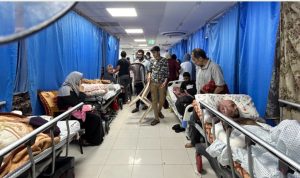
“The whole hospital was filled with tens of thousands of displaced persons, living in the operating theaters, in the corridors, in the stairways. And the emergency department was seeing hundreds of patients a day, mostly trauma, with only a handful, literally five or six doctors or nurses, to care for all of those people.”
Casey said he saw “patients on the floor, so many you could barely move without stepping on somebody’s hands or feet.”
He spoke of patients at Al-Ahli hospital, also in northern Gaza, lying on church pews “basically waiting to die” in a hospital with no fuel, no power, no water, very little in the way of medical supplies and only a handful of staff remaining to take care of them.
Further south, at Al-Nasr medical complex in Khan Younes, only about 30 percent of staff remain, Casey said, and the facility is at about 200 percent of its bed capacity, with patients crammed into corridors and lying on floors. In its burns unit, one physician provides care for about 100 patients.
“So its a really horrifying situation in the hospitals,” he added.
He also described the challenges faced every day in attempts to organize aid convoys to deliver desperately needed fuel and relief supplies, and to send more surgeons, doctors and nurses to the hospitals “to try to save life and limb, to avoid unnecessary amputations, to treat the many children that I saw with terrible shrapnel injuries and gunshot wounds, and to establish field hospitals.”
Rafah, on Gaza’s border with Egypt, now hosts about 1 million displaced people, an almost four-fold increase on the 270,000 that were there just a few weeks ago.
The area “doesn’t have the healthcare infrastructure to deal with this huge influx of internally displaced persons,” Casey said. “It doesn’t have the physical space to host these people. They’re on the sidewalks, on the street.”
He said the WHO is working to set up additional field hospitals and provide more healthcare workers to replace those who were forced to flee for their lives, and to meet the significantly increased burden of care created by injuries and illnesses caused by the conflict and the atrocious living conditions.
Displaced people who have lost most of their possessions are forced to sleep in tents with little or no access to the basic requirements for life, including food, clean water, heat and proper shelter, exposing them to infectious diseases, he added.