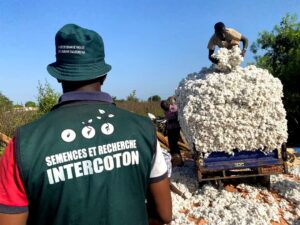
KORHOGO, Ivory Coast Dec 7 (Reuters) – Without pausing to wipe the sweat from their brows, workers in northern Ivory Coast picked cotton by the handful – a crop saved by the use of extra insecticides after a new pest wreaked record damage across West and Central Africa last season.
The Indian cotton jassid or Amrasca biguttula insect appeared as if from nowhere across much of the region’s cotton belt in 2022-23, injecting a toxin into the plants that led to a near 25% production slump year-on-year. Some countries lost over half their forecast harvest.
“It destroyed us. It spoiled all the fields,” recalled Issouf Kabe Coulibaly, who along with other farmers in the Ivorian department of Korhogo struggled to support his family and racked up debts due to last season’s losses.
The crisis highlighted the region’s vulnerability to invasive species and a reliance on chemical solutions that research shows will not in the long term protect a crop that supports millions and is a prized foreign currency earner for cash-strapped governments from Benin to Burkina Faso.
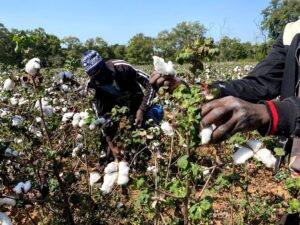
This year, the use of rapidly trialled and approved new pesticides has kept the tiny grasshopper-like insects at bay.
Production across West and Central Africa’s 10 cotton-growing countries is forecast to hit 4.9 million 480-pound bales in 2023-24 – a 22% rebound from the previous marketing season, the U.S. Department of Agriculture (USDA) said in September.
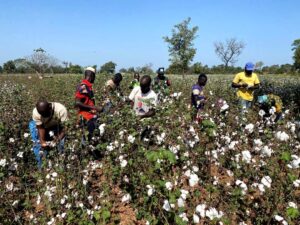
By harvest time in late November, the sun-soaked fields around Korhogo were so thick with cotton bolls they appeared frosted. Working in a line, the labourers plucked the white puffs from waist-high plants and stuffed them into sacks.
“If the medicine had not been effective we would not have had enough cotton this year. Thank God we believe a solution has been found,” said farmer Yaridiouma Soro, whose harvest was around two thirds smaller than usual last season.
FARMERS’ HESITANCY
When the full scale of the jassid crisis became clear last season, cotton producers knew urgent action was needed.
“The scale was unprecedented. We had never seen this … the year was catastrophic,” said Eugene Konan, head of research and development at COIC, one of the largest Ivorian cotton firms.
Much was at stake. Cotton provides 8-12% of the gross domestic product of Benin, Burkina Faso, Chad, and Mali, according to World Trade Organization data from 2019, when the four were the region’s top producers.
Experts from the eight-nation PR-PICA cotton production programme joined forces to find a solution before the sowing season kicked off in May, testing and recommending three new pesticides for farmers in the region to use.
“In the short term, it’s the obvious choice. This year they could not afford to lose 30 or 50% of production again,” said Thierry Brevault, who studies how to sustainably intensify crop production at French agricultural research centre CIRAD.
Across West Africa, anxious farmers treated their cotton with the new chemicals as instructed.
“We had a product to fight the bug but we were all afraid – I reduced my surface area by almost 5 hectares,” said Coulibaly, who usually plants up to 15 hectares.
The USDA said similar hesitation has led to a 5% year-on-year drop in the area planted with cotton in Ivory Coast and an 8% drop in Benin with some farmers switching crops entirely.
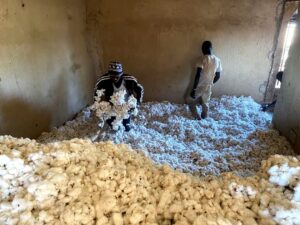
The worries were unfounded. At Coulibaly’s farm, workers tossed armfuls of cotton onto a truck headed to a depot, where it was heaped into huge drifts – testament to the efficacy of the new chemical regime.
“We hope that next year all our producers will return to cultivation,” said COIC’s Konan.
VICIOUS CYCLE
The bounce back may be short-lived however and researchers warn that more work needs to go into finding long-term solutions.
Insecticides should be used against Amrasca biguttula only with precaution as known cases of resistance have been reported in India and Pakistan, according to the Industry group Insecticide Resistance Action Committee (IRAC).
“In West Africa, the answer remains the use of insecticides … But it doesn’t really solve the problem. It’s a vicious cycle,” Brevault said by phone.
“We will encounter resistance sooner or later. Eventually these products will no longer work.”
Developing pest-resistant cotton varieties, expanding the use of monitoring systems so chemicals are only used when needed, researching alternative bio-controls, and learning how to tackle jassids at a different part of their life cycle should be prioritised, he said.
The economic argument for investing in sustainable tools is clear. Biological invasions cost Africa up to $79 billion between 1970 and 2020, mostly due to the damage they caused, according to a 2021 study in the journal Niobiota that warned that such costs were increasing exponentially over time.
“We can expect more and more new invasives to come to the region – to West African countries,” said entomologist Lakpo Koku Agboyi at the non-profit Centre for Agriculture and Bioscience International (CABI).
He said this was partly due to weak border controls that allowed non-native species to hitch a lift undetected from elsewhere and warming temperatures, which can change a species’ range or spur its spread.
Genetic tests show the new jassid in West Africa found its way over from Asia although it’s not known when this happened or what caused its population to explode, said Brevault, who ruled out climate change as a factor.
Some farmers in Korhogo are wary of the chemical approach to tackling pests.
“For me it’s the pesticides that are not very effective,” said septuagenarian Navaga Tuo, standing in a field that was brown rather than white. He decided to plant maize this season after losing much of his cotton in 2022-23.
Encouraged by his neighbours’ bountiful harvests, Tuo plans to return to cotton next season and protect his crop as directed, but he is concerned about using more chemical sprays.
“We must find a solution to eliminate the jassids. Apart from agriculture we have no other profession,” he said, plucking corn cobs from dried-out stalks and tossing them to the ground.